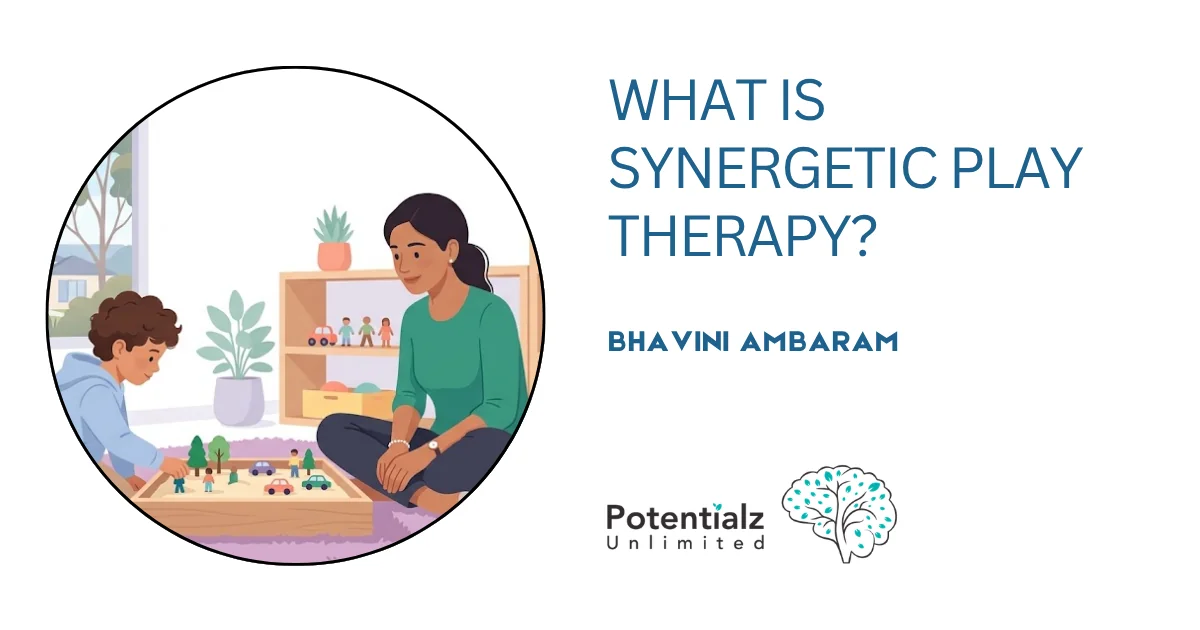
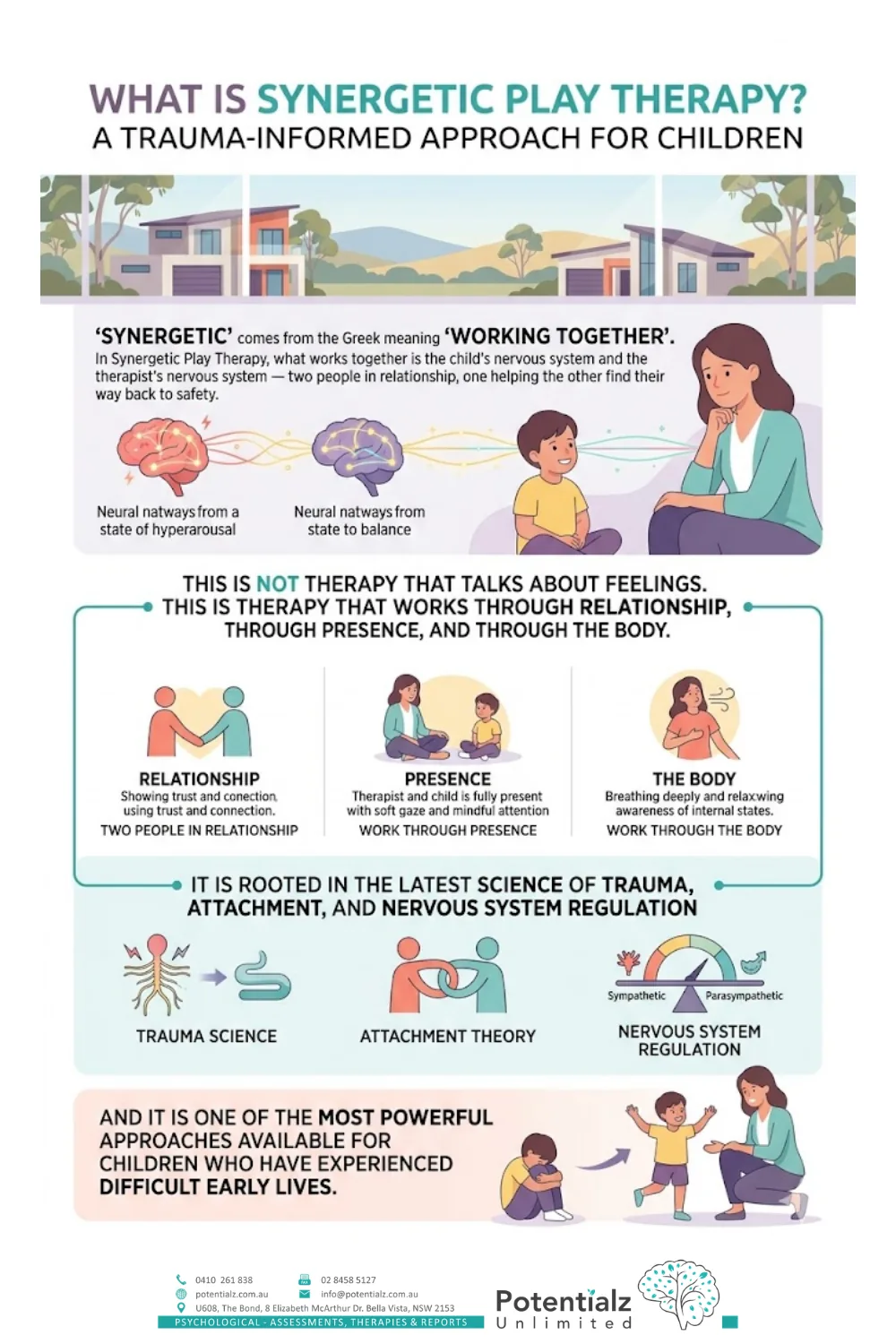
The word “synergetic” comes from the Greek meaning “working together.” In Synergetic Play Therapy, what works together is the child’s nervous system and the therapist’s nervous system — two people in relationship, one helping the other find their way back to safety.
This is not therapy that talks about feelings. This is therapy that works through relationship, through presence, and through the body. It is rooted in the latest science of trauma, attachment, and nervous system regulation — and it is one of the most powerful approaches available for children who have experienced difficult early lives.
As a certified Synergetic Play Therapy practitioner at Potentialz Unlimited in Bella Vista, I use this approach with children whose struggles go beyond what words can easily reach. If your child has experienced trauma, has intense emotional responses, or seems to be carrying something that conventional approaches have not touched, this post is for you.
Who Developed Synergetic Play Therapy?
Synergetic Play Therapy (SPT) was developed by Lisa Dion, a licensed professional counsellor and registered play therapist supervisor based in the United States. Dion began developing the model in the early 2000s, drawing together multiple frameworks from neuroscience, attachment theory, trauma-informed practice, and mindfulness.
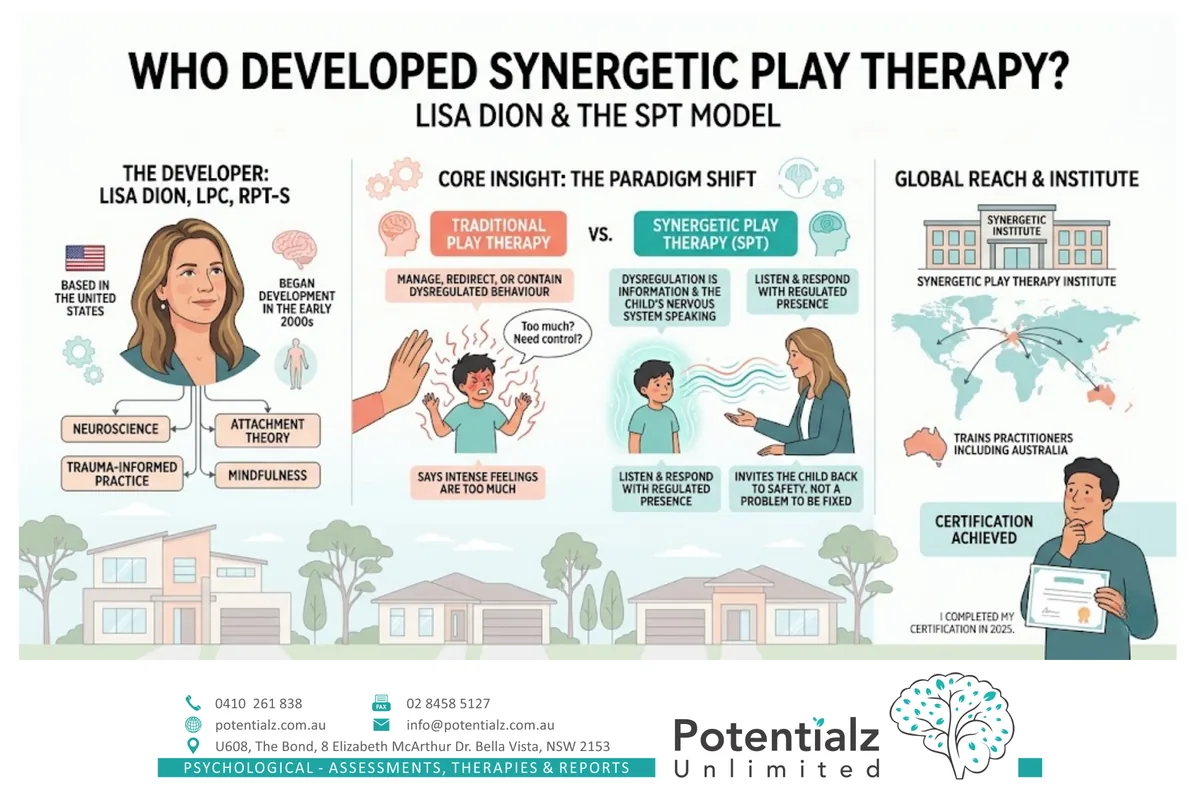
Lisa Dion’s insight was that traditional play therapy sometimes tries to manage, redirect, or contain children’s dysregulated behaviour — which can inadvertently send the message that the child’s intense feelings are too much or need to be controlled. Synergetic Play Therapy takes a fundamentally different position: dysregulation is not a problem to be fixed. It is information. It is the child’s nervous system speaking, and the therapist’s job is to listen — and to respond with a regulated presence that invites the child back to safety.
Dion founded the Synergetic Play Therapy Institute, which now trains practitioners in multiple countries, including Australia. I completed my certification in 2025.
The Core Principles of Synergetic Play Therapy
To understand Synergetic Play Therapy, it helps to understand the principles that underpin it.
The nervous system is central. SPT is grounded in the understanding that most children’s emotional and behavioural difficulties are expressions of nervous system dysregulation. This includes children who have experienced trauma, children with attachment difficulties, children with ASD and ADHD, and children with anxiety and conduct issues. The therapy works at the level of the nervous system, not just the cognitive or behavioural level.
Co-regulation comes before self-regulation. Children learn to regulate their own nervous systems through repeated experiences of being in relationship with a regulated other. This is how infants develop regulation — through the attuned presence of a caregiver. SPT recreates this foundational experience in the therapeutic relationship. The therapist’s own regulated nervous system is a primary therapeutic tool.
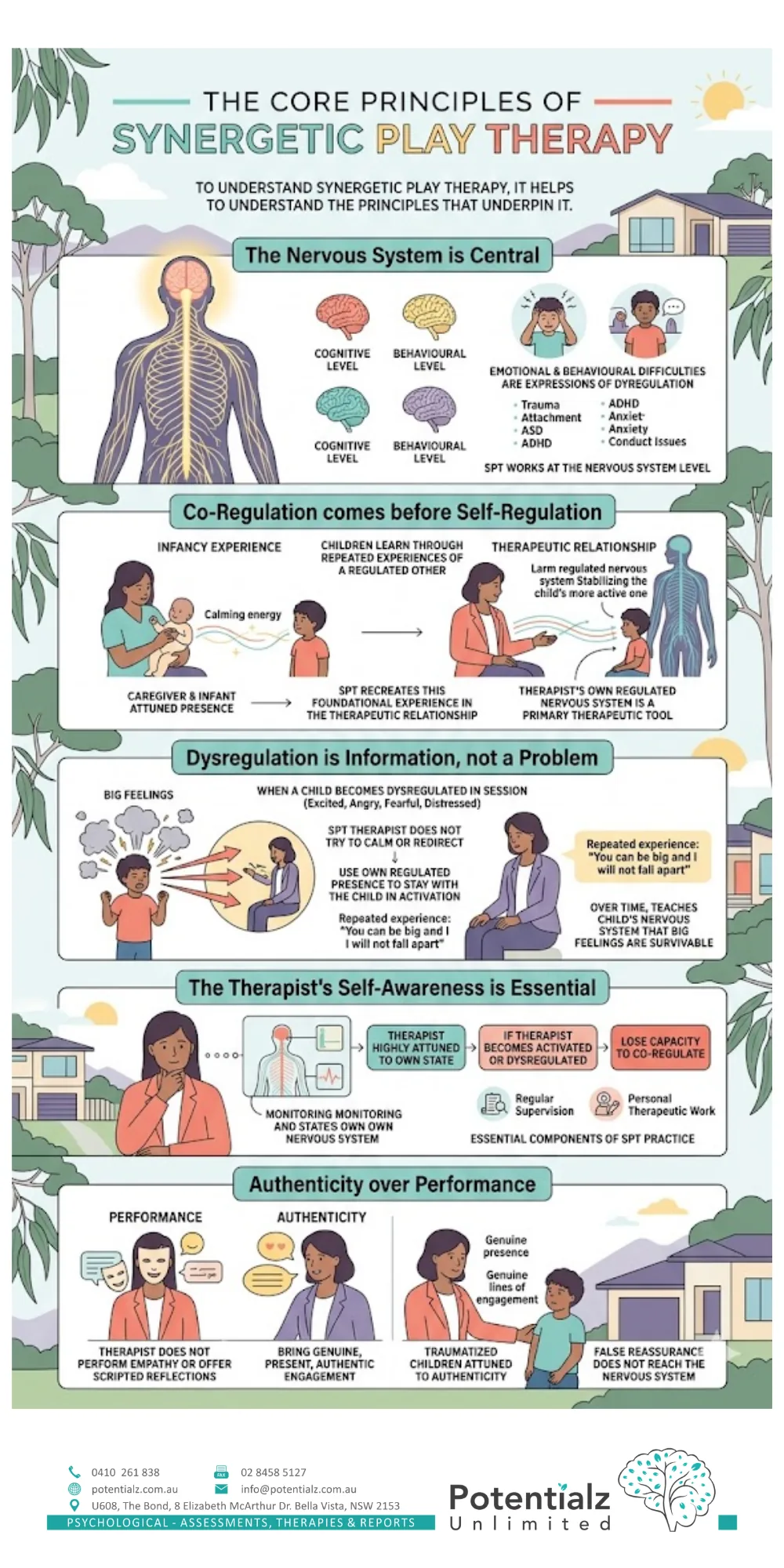
Dysregulation is information, not a problem. When a child becomes dysregulated in session — excited, angry, fearful, distressed — an SPT therapist does not try to calm the child down or redirect the behaviour. Instead, the therapist uses their own regulated presence to stay with the child in that activation, providing the experience that “you can be big and I will not fall apart.” Over time, this repeated experience teaches the child’s nervous system that big feelings are survivable.
The therapist’s self-awareness is essential. SPT requires therapists to be highly attuned to their own nervous system states. If the therapist becomes activated or dysregulated by the child’s behaviour, they lose their capacity to co-regulate. Regular supervision and personal therapeutic work are considered essential components of SPT practice.
Authenticity over performance. In SPT, the therapist does not perform empathy or offer scripted reflections. They bring genuine, present, authentic engagement to every moment of the session. Children — especially traumatised children — are exquisitely attuned to authenticity, and false reassurance does not reach the nervous system.
How Synergetic Play Therapy Differs From Traditional Play Therapy
Traditional play therapy — particularly child-centred play therapy in the Rogerian tradition — provides a non-directive, safe space where children can express themselves through play with minimal therapist direction. This is powerful and effective for many children.
Synergetic Play Therapy builds on this foundation but adds specific attention to the nervous system dimension of the therapeutic relationship. The key differences include:
Active use of the therapeutic relationship as a regulatory tool. In traditional play therapy, the therapist creates conditions for healing through the relationship. In SPT, the relationship is explicitly understood through a nervous system lens, and the therapist actively uses co-regulation as a therapeutic strategy.
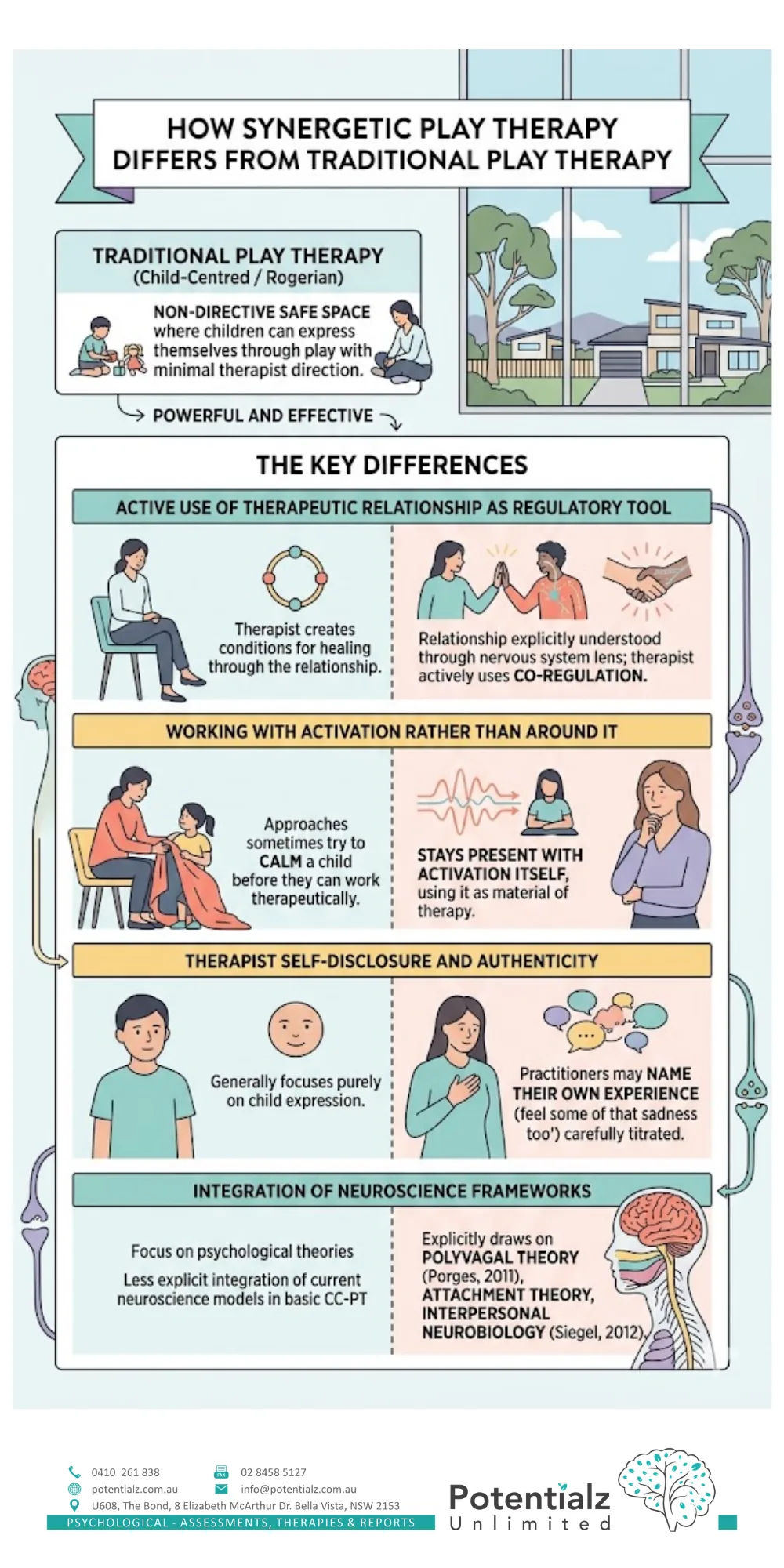
Working with activation rather than around it. Traditional approaches sometimes try to calm a child before they can work therapeutically. SPT stays present with the activation itself, using it as the material of therapy.
Therapist self-disclosure and authenticity. SPT practitioners may name their own experience in the room (“I notice I feel a bit of that sadness too”) in ways that are carefully titrated to support the child’s regulatory experience without shifting focus away from the child.
Integration of neuroscience frameworks. SPT explicitly draws on polyvagal theory (Porges, 2011), attachment theory, and interpersonal neurobiology (Siegel, 2012) as explanatory frameworks for what happens in sessions.
The Neuroscience Behind Synergetic Play Therapy
Three bodies of research are particularly central to the SPT model.
Polyvagal Theory, developed by neuroscientist Stephen Porges, proposes that the autonomic nervous system has three primary states: a safe, socially engaged state (ventral vagal); a mobilised survival state of fight or flight (sympathetic); and a shutdown state of freeze or collapse (dorsal vagal). Trauma and difficult early experiences often leave children predominantly in the sympathetic or dorsal vagal states — even when they are objectively safe. SPT aims to help children spend more time in the ventral vagal, socially engaged state through repeated experiences of safe relationship (Porges, 2011).
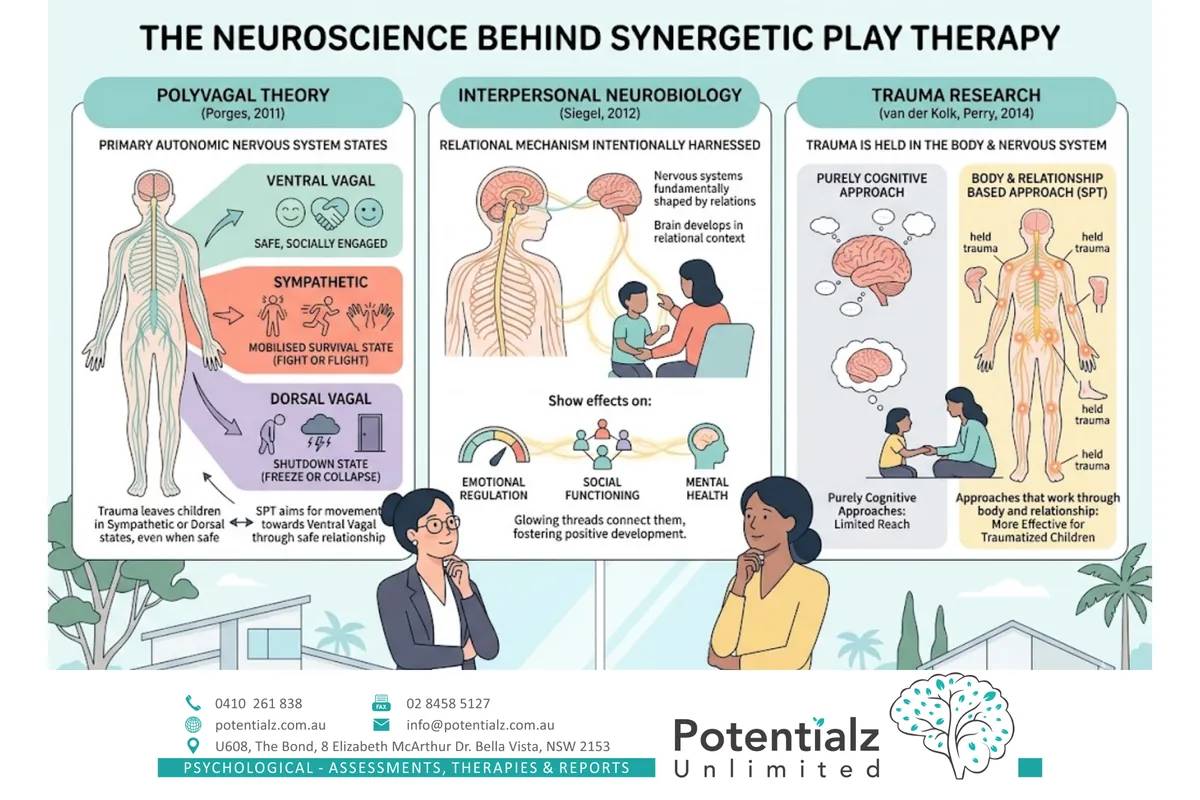
Interpersonal Neurobiology, developed by psychiatrist Daniel Siegel, describes how our nervous systems are fundamentally shaped by our relationships — particularly our early attachment relationships. The brain develops in a relational context, and the quality of that relational context has profound effects on emotional regulation, social functioning, and mental health (Siegel, 2012). SPT harnesses this relational mechanism intentionally.
Trauma research by clinicians including Bessel van der Kolk and Bruce Perry has established that trauma is held in the body — in the nervous system — rather than only in memory and cognition. This means that purely cognitive approaches to trauma treatment have limited reach. Approaches that work through the body and through relationship are more effective for traumatised children (van der Kolk, 2014). For a deeper look at how early adverse experiences shape long-term wellbeing, see Dr. Gurprit Ganda’s article on childhood trauma and its importance in a healthy life.
Who Benefits From Synergetic Play Therapy?
Research and clinical experience suggest that SPT can be beneficial for a wide range of children. It is particularly well-suited for:
Children who have experienced trauma. This includes children who have experienced abuse, neglect, family violence, medical trauma, bereavement, or other adverse childhood experiences. SPT works at the level of the nervous system, where trauma is held, rather than requiring children to talk about or cognitively process what happened to them.
Children with attachment difficulties. Children who have experienced disrupted, inconsistent, or frightening caregiving often have disorganised attachment and significant relational difficulties. SPT provides a safe, attuned relationship that can begin to repair attachment patterns.
Children with ASD. Autistic children often have nervous systems that are more sensitive to sensory input, social demands, and change. SPT’s acceptance of the child’s regulation state — rather than demands for the child to regulate to neurotypical norms — is particularly supportive for autistic children. Our child psychology services can complement this work.
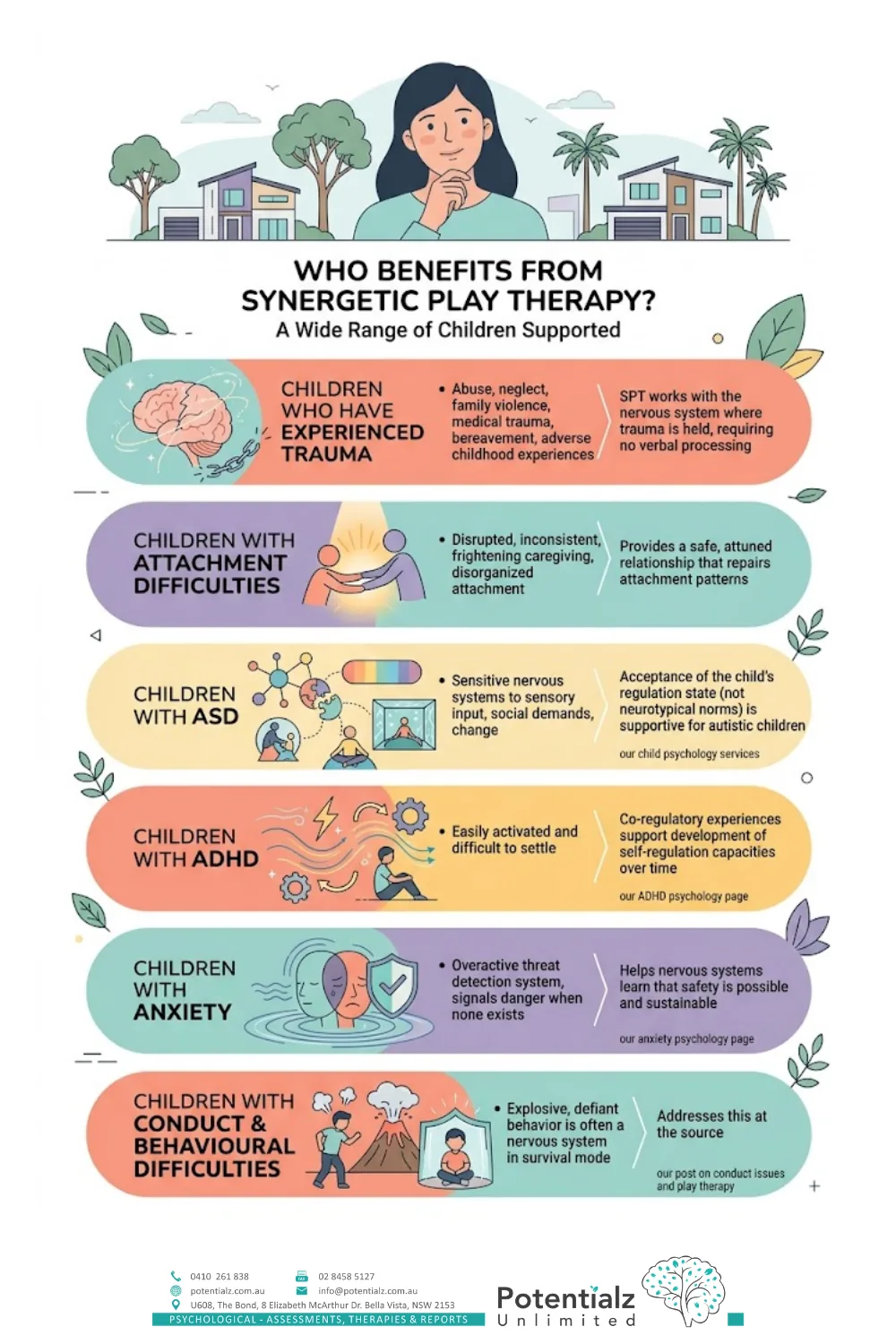
Children with ADHD. Children with ADHD often have nervous systems that are easily activated and difficult to settle. The co-regulatory experience of SPT sessions, over time, can support the development of self-regulation capacities. For more on this, see our ADHD psychology page.
Children with anxiety. Anxiety is, at its root, a nervous system response — the threat detection system is overactive, signalling danger when none exists. SPT helps children’s nervous systems learn that safety is possible and sustainable. More information is available on our anxiety psychology page.
Children with conduct and behavioural difficulties. Explosive and defiant behaviour is often an expression of a nervous system in survival mode. SPT addresses this at the source. See our play therapy services in Bella Vista for more information.
What Does a Synergetic Play Therapy Session Look Like?
A Synergetic Play Therapy session at Potentialz Unlimited is 50 minutes long and takes place in a fully equipped play therapy room. The room contains a range of materials — art supplies, sand tray, puppets, dolls, LEGO, sensory items, and other expressive media — that give the child multiple ways to express what they are experiencing.
The session is largely child-led. I follow the child’s play rather than directing it. But I am not a passive observer — I am actively present, tracking the child’s nervous system state moment by moment, noting shifts in their activation level, and responding with my own regulated presence.
When a child becomes activated — when they begin to feel unsafe, overwhelmed, or triggered — I do not try to redirect, distract, or calm them artificially. Instead, I stay present with them in that state. I might reflect what I notice: “That looks really big right now.” I might offer a grounded, calm body presence that invites co-regulation. I might gently introduce a regulatory strategy — a breath, a physical anchor — when the child is ready to receive it.
The goal is not for the child to perform wellness in session. The goal is for the child’s nervous system to have repeated experiences of: “I can feel big feelings, and it is safe. Something bad does not have to happen. I can come back.”
Parent Involvement in Synergetic Play Therapy
Parent involvement is an important component of SPT, for two reasons. First, parents are the child’s primary co-regulators outside the therapy room. What happens between sessions — the quality of the parent-child relationship, the predictability of the home environment, the parent’s own regulation — shapes the child’s progress in therapy. Working with parents to support their own nervous system regulation and their capacity to co-regulate with their child amplifies therapeutic gains.
Second, some children’s difficulties are partly rooted in the parent-child relationship itself. This is not a matter of parental blame — parents who struggle to co-regulate with their children are usually working from their own nervous system history. SPT-informed parent work is compassionate, practical, and transformative.
At Potentialz Unlimited, I offer parent consultations alongside child sessions. These sessions are focused on helping you understand your child’s nervous system, developing practical strategies for home, and supporting your own wellbeing as a parent.
Key Takeaways
- Synergetic Play Therapy was developed by Lisa Dion and is grounded in neuroscience, attachment theory, and polyvagal theory.
- It works at the level of the nervous system, using the therapeutic relationship and co-regulation as primary tools for healing.
- Dysregulation in session is treated as information and an opportunity for healing — not as a problem to be managed.
- SPT is particularly beneficial for children who have experienced trauma, attachment difficulties, ASD, ADHD, anxiety, and conduct issues.
- Parent involvement is an integral part of the SPT process.
- Bhavini Ambaram at Potentialz Unlimited in Bella Vista holds a 2025 certification in Synergetic Play Therapy and offers sessions for children aged 3 to 12.
How Potentialz Can Help
At Potentialz Unlimited in Bella Vista, I offer Synergetic Play Therapy as part of a comprehensive, trauma-informed approach to child therapeutic support. My sessions are individually tailored, culturally sensitive, and grounded in the latest evidence about what supports healing in children.
I work with children aged 3 to 12 and have experience with families from diverse backgrounds, including those with connections to Australia, South Africa, and India. I understand that taking the step to seek help for your child can feel daunting — and I am committed to making that process as supported and clear as possible.
Book a session online: live.potentialz.com.au/online-scheduling Call us: 0410 261 838 Visit us: Unit 608, 8 Elizabeth Macarthur Drive, Bella Vista NSW 2153
You can also explore our full range of play therapy services in Bella Vista, our support for child anxiety, and our child psychology services. For psychological assessment, diagnosis, or treatment of mental health conditions, our team of AHPRA-registered psychologists is available.
References (APA 7th Edition)
Dion, L. (2018). Aggression in play therapy: A neurobiological approach for integrating intensity. W. W. Norton & Company.
Porges, S. W. (2011). The polyvagal theory: Neurophysiological foundations of emotions, attachment, communication, and self-regulation. W. W. Norton & Company.
Siegel, D. J. (2012). The developing mind: How relationships and the brain interact to shape who we are (2nd ed.). Guilford Press.
Siegel, D. J., & Bryson, T. P. (2012). The whole-brain child: 12 revolutionary strategies to nurture your child’s developing mind. Delacorte Press.
van der Kolk, B. A. (2014). The body keeps the score: Brain, mind, and body in the healing of trauma. Viking.
Related Reading on potentialz.com.au
- Play Therapy Services in Bella Vista
- Child Psychology Services
- Anxiety Psychology Services
- ADHD Psychology Services
- Our Team
- Contact us
Disclaimer: This information is general in nature. Bhavini Ambaram is a Practitioner in Therapeutic Play accredited by Play Therapy International (PTUK/PTSA) and is not AHPRA-registered as a psychologist or counsellor. For psychological assessment, diagnosis, or treatment of mental health conditions, please consult an AHPRA-registered practitioner. The team at Potentialz Unlimited includes AHPRA-registered psychologists.
Crisis support: If you or someone you know needs immediate support, please contact Lifeline on 13 11 14, Beyond Blue on 1300 22 4636, Kids Helpline on 1800 55 1800, or call 000 in an emergency.
Knowledge Check Quiz
Test what you have just read. Choose your answer for each question, then submit to reveal the answers and your score.
Need Professional Support?
If you're experiencing mental health concerns, our team is here to help.